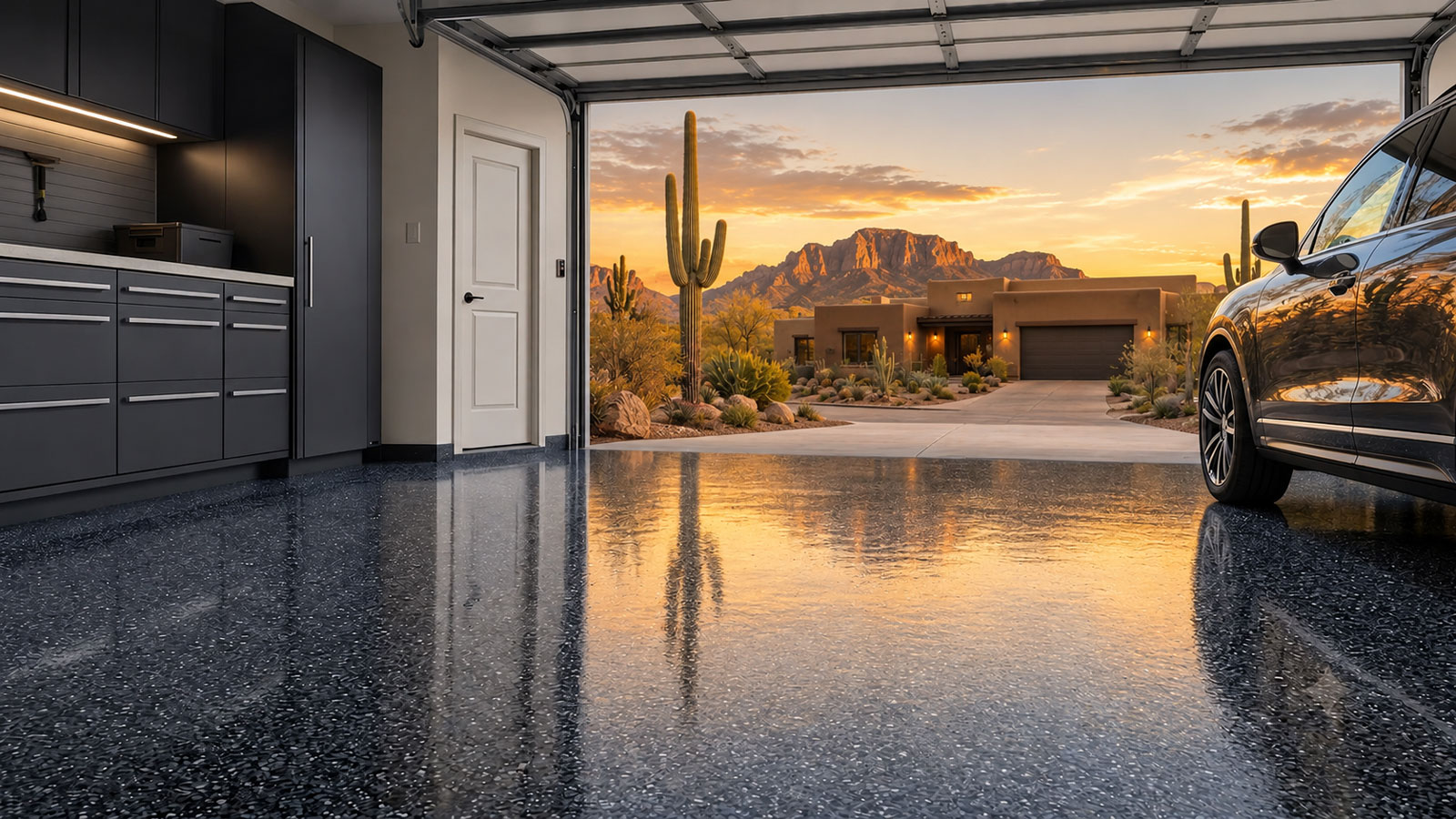
Garage Floor Coating in Green Valley, AZ
Floor Coating Services in Green Valley, AZ
Green Valley is an unincorporated Pima County community south of Tucson with a particularly distinctive development history. Local civic materials date its planned retirement-community beginnings to 1964 and describe its creation as a self-contained residential center. The Green Valley Council incorporated in 1973 to coordinate homeowners associations and county relationships; its current materials describe roughly 80 member HOAs. Those details distinguish the area's neighborhood structure from incorporated Sahuarita but do not indicate when any garage slab was poured.
Many Green Valley properties are governed by specific association rules, but a home's HOA membership is not a test of concrete condition or a guarantee about coating permissions. A garage may have been added, repoured, painted or sealed at a different time from the dwelling. The owner's actual slab and any applicable association or exterior-work requirements should be checked independently. Meanwhile, the desert setting brings dust, hot surfaces and occasional monsoon runoff.
A suitable epoxy, polyaspartic or decorative-flake floor can help keep sound prepared concrete clean, particularly where a garage sees regular parking, storage or recreation equipment. It cannot redirect rainwater, cure moving cracks or compensate for old paint left beneath it. Compare installation bids by their substrate assessment, grinding, repairs, texture, full-system UV behavior and curing.
Local Market Insight
Green Valley began as a planned retirement community in 1964; its civic council incorporated in 1973 and now describes about 80 HOAs. It remains unincorporated Pima County, making association rules and county planning separate from actual slab readiness.
What Affects the Cost of Garage Floor Coating in Green Valley?
Green Valley's multiple residential development periods can create varied old coatings, repairs and access requirements. A garage in a long-established association may have a later replacement slab, while newer concrete still needs sealer and cure-history checks.
An accurate bid should consider actual surface defects, any driveway water entry and the finish's cleaning and temperature requirements rather than generalizing about planned communities.
- Past floor treatments: A garage used for years of parking or hobbies may have earlier paint, epoxy or sealer. Inspect compatibility and remove unsuitable films before applying a new system.
- Slab history across development phases: Home and garage construction dates can differ. Check patches, concrete strength and crack movement instead of assuming the community's 1964 origin defines every slab.
- HOA coordination and access: Green Valley's association structure can affect project logistics or exterior work permissions. Owners should verify applicable rules, while the installer measures actual staging and garage clearance.
- Monsoon water and thresholds: Seasonal runoff should be evaluated at the specific driveway and gutters. Decorative coatings cannot redirect water or act as flood barriers.
- Heat, dust and sun exposure: Hot concrete and direct sun at an open garage affect finish and application. Consider UV behavior, temperature limits and texture that is practical to sweep.
- Cracks and cure schedule: Repairable defects, old patches and product curing requirements influence scope. A coating cannot stabilize ongoing structural movement; cars must remain out until permitted.
Call for a clear, project-specific estimate — or request one online.
Green Valley's 1964 Beginnings and Many HOA Garage Histories
Green Valley's civic history describes the community's development as a planned retirement center beginning in 1964. Its Homeowners Association representatives formed the Green Valley Council in 1973 as a voice to Pima County, and current council information describes approximately 80 HOAs. The community is unincorporated, meaning county rather than municipal government administers many public responsibilities. These are specific organizational and development facts, not an indication that private concrete is uniformly old or new.
An established Green Valley home may have a garage added or repoured long after original construction. Another garage may have received floor paint or sealer from previous owners. Before coating, ask what is known about the slab, then inspect oil, old finishes, patching, concrete soundness and cracks. The actual surface controls repair needs.
HOA rules may be relevant to access, scheduling or visible exterior changes, so an owner should verify applicable requirements. But association approval does not establish whether epoxy will adhere or whether moisture is suitable. Mechanical profiling, removal of incompatible coatings and appropriate repairs remain independent technical tasks.
Compare bids based on those specific steps, not on the number of homes in an association. A written scope should include grinding, crack treatment, layers, texture, garage clearance and the time before vehicles can be returned.
Desert Maintenance and Monsoon Planning in Green Valley
Green Valley sits in the southern Tucson desert region near the Santa Cruz River corridor, where seasonally concentrated storms can create runoff despite long dry periods. Pima County manages flood-control functions for this unincorporated community. A regional river or drainage system is important context, but it cannot determine whether water enters an individual garage or whether the concrete is damp.
A homeowner should look for actual runoff paths at the driveway, water marks near the overhead door and gutter discharge. Ordinary wet tires or garden equipment may also bring water and mud indoors. Persistent unexplained dampness can require appropriate moisture testing before selecting a coating system.
An epoxy or polyaspartic finish cannot redirect stormwater, replace proper grading or stop an active structural crack. On sound prepared concrete, however, a continuous surface may simplify sweeping the desert dust and grit that accumulate in garages used for parking and household storage.
Choose topcoat texture with cleaning and grip in mind. Ask about direct sun at the entrance, product temperature limits and the realistic curing period. Those considerations provide more value than a generic coating recommendation based on retirement-community identity.
Frequently Asked Questions
Is Green Valley an incorporated town like Sahuarita?
No. Green Valley is unincorporated Pima County, with local HOA representation through the Green Valley Council.
Does a 1960s Green Valley home mean the garage slab is that old?
No. Garages and concrete may have been added or replaced later; inspect the actual slab and previous finishes.
Do HOA rules determine whether a floor coating will work?
No. Associations may have applicable project rules, but adhesion, moisture and preparation depend on the floor and the manufacturer's requirements.
Can epoxy protect against monsoon water entering a garage?
No. Exterior drainage and grade problems need separate correction. Resin finishing is not floodproofing.
What should a Green Valley coating quote specify?
Ask for inspection, old-coating removal, grinding, cracks and repairs, moisture checks if indicated, texture, full layers and cure timing.
Green Valley Neighborhoods & Local Context
Phone Quote Line
Speak with a floor coating specialist about your project and get a realistic estimate range.
(520) 727-4488Typical Project Cost
$3,000–$5,500
Typical range for a two-car garage. Final pricing depends on floor size, concrete condition, prep work, coating type, and finish options.
Helpful Guides